The Ocean's Darkest Secret: What Scientists Won't Tell You About Orca Attacks
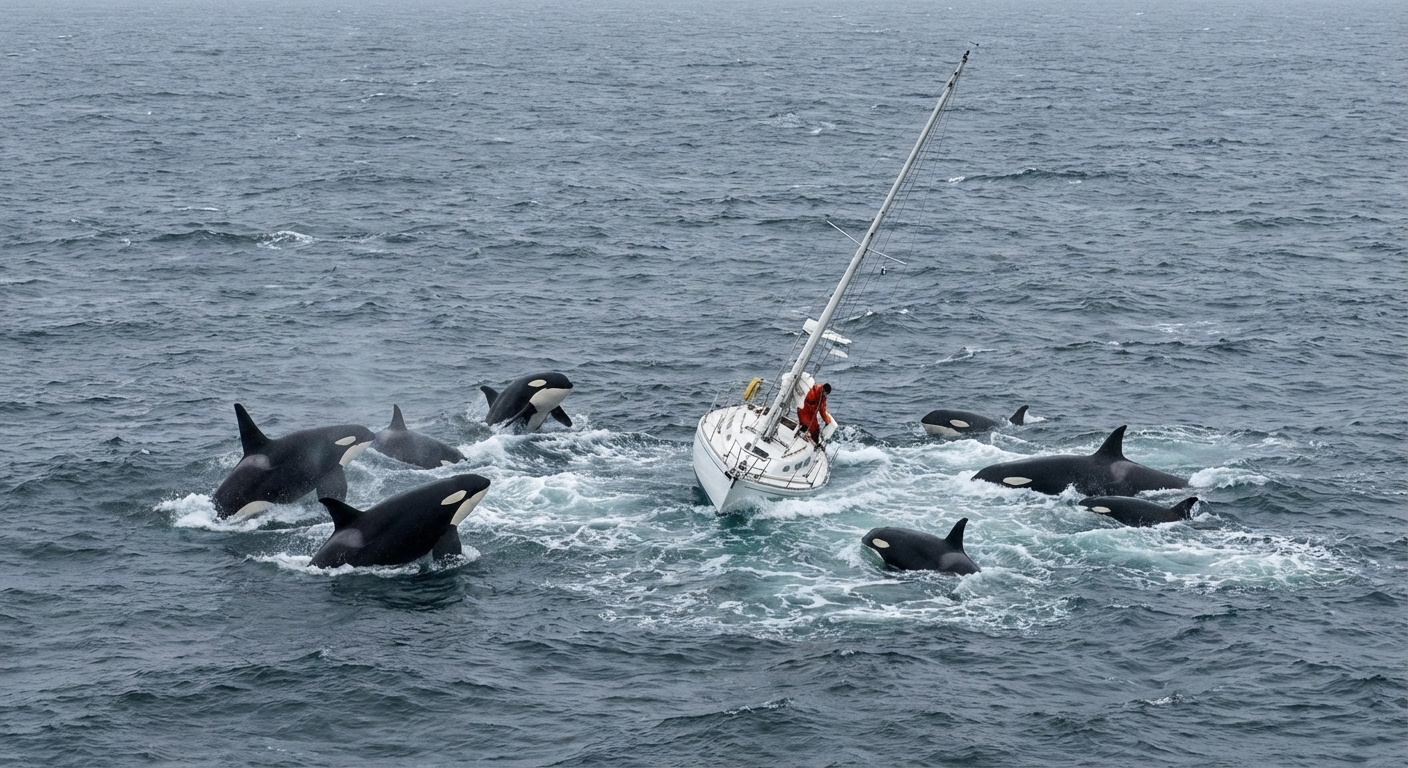
The morning of May 3rd, 2023, started like any other for a Spanish sailor off the Strait of Gibraltar. Then, without warning, his yacht's rudder shattered under the impact of something massive and intelligent. As he scrambled to assess the damage, he saw them—a pod of orcas, circling with what witnesses describe as deliberate precision.
This wasn't an isolated incident.
Over the past five years, documented interactions between orcas and boats have skyrocketed from a handful of anecdotal reports to nearly 200 confirmed incidents. What started as curiosity has evolved into something far more disturbing: a coordinated, seemingly intentional campaign against vessels in European waters.
A Pattern Too Precise to Ignore
The data is undeniable. Orcas are no longer randomly attacking boats—they're targeting specific vessel types, primarily white yachts between 25-35 feet. They're ramming rudders with surgical accuracy, disabling boats without harming humans. Some researchers whisper of something even more unsettling: selective targeting.
"It's almost like they're... communicating something," one marine biologist admitted off the record, her voice trailing into uncomfortable silence.
The attacks follow no natural predatory logic. They're not feeding. They're not defending territory in the traditional sense. They're sending a message—but to whom, and about what?
The Theory No One Wants to Discuss
Marine scientists have proposed various explanations:
- Revenge hypothesis: Could orcas be retaliating against specific human activities? Some pods have lost family members to ship strikes and fishing operations.
- Territorial reclamation: Are they reclaiming waters that historically belonged to them?
- Learned behavior: Did one traumatized orca teach others to target boats, creating a cultural phenomenon?
Each theory raises more questions than it answers. The unsettling truth? We simply don't know. And that uncertainty is spreading faster than the attacks themselves.
The Eerie Intelligence Factor
What makes this phenomenon truly disturbing isn't the attacks—it's the intelligence behind them.
Orcas possess some of the most advanced cognitive abilities in the animal kingdom. They teach, they strategize, they remember. They hold grudges. Some researchers have documented orcas passing down hunting techniques across generations, creating distinct "cultures" within pods.
Now, consider this: What if they're not attacking boats randomly? What if they're choosing which boats to target based on some criteria we haven't deciphered?
Witnesses report orcas observing boats for hours before attacking. They coordinate with precision. They stop when humans abandon ship—almost as if they're making a statement rather than hunting prey.
The Growing Fear Among Sailors
Yacht clubs from Spain to Portugal are implementing emergency protocols. Some insurance companies have started refusing coverage for certain Mediterranean routes. Experienced sailors—men and women who've spent decades at sea—are abandoning planned voyages out of sheer fear.
"It's not rational," one captain confessed. "But when you see that dorsal fin on the horizon, and you know what it means... something primal wakes up inside you."
The psychological impact is real. Mariners report anxiety, insomnia, and a new phenomenon researchers are calling "cetacean hypervigilance." The ocean, once a place of freedom and adventure, has become hostile territory for some.
What Happens Next?
The scientific community remains divided. Some argue we're witnessing natural behavior we've simply never documented before. Others suggest environmental collapse is driving orcas to desperate measures. A few—though they rarely speak publicly—wonder if we're witnessing the early stages of something unprecedented: organized animal resistance.
What we know for certain:
- The attacks are increasing in frequency
- The targeting appears deliberate
- Orcas are communicating these behaviors to younger generations
- Human intervention remains ineffective and potentially dangerous
The question haunting marine biologists isn't whether the attacks will continue. It's how far they'll escalate.
The Uncomfortable Truth
Orcas are apex predators with intelligence rivaling our own. They've lived in Earth's oceans for millions of years, developing complex social structures and communication systems we're only beginning to understand. For centuries, we've treated the ocean as our domain—extracting, polluting, and dominating without consequence.
Perhaps what's truly unsettling isn't that orcas are attacking boats.
Perhaps it's that we're finally listening.
What You Can Do
If you're planning Mediterranean voyages, stay informed through official maritime channels. Report any unusual orca behavior to marine authorities. And perhaps most importantly: respect the ocean and its inhabitants as the intelligent, autonomous beings they are.
The attacks may continue. The mystery may deepen. But one thing is certain—the relationship between humans and orcas has fundamentally changed. And we may never fully understand why.