When Scientists Attached a Camera to a Shark, They Discovered Something That Challenges Everything We Thought We Knew
The ocean has always been humanity's final frontier—vast, mysterious, and full of secrets we're only beginning to uncover. But in recent years, marine biologists have started using cutting-edge technology to peer into the hidden lives of the ocean's most apex predators. What they found in the footage from one particular great white shark wasn't just surprising. It was deeply unsettling.
The Experiment That Changed Everything
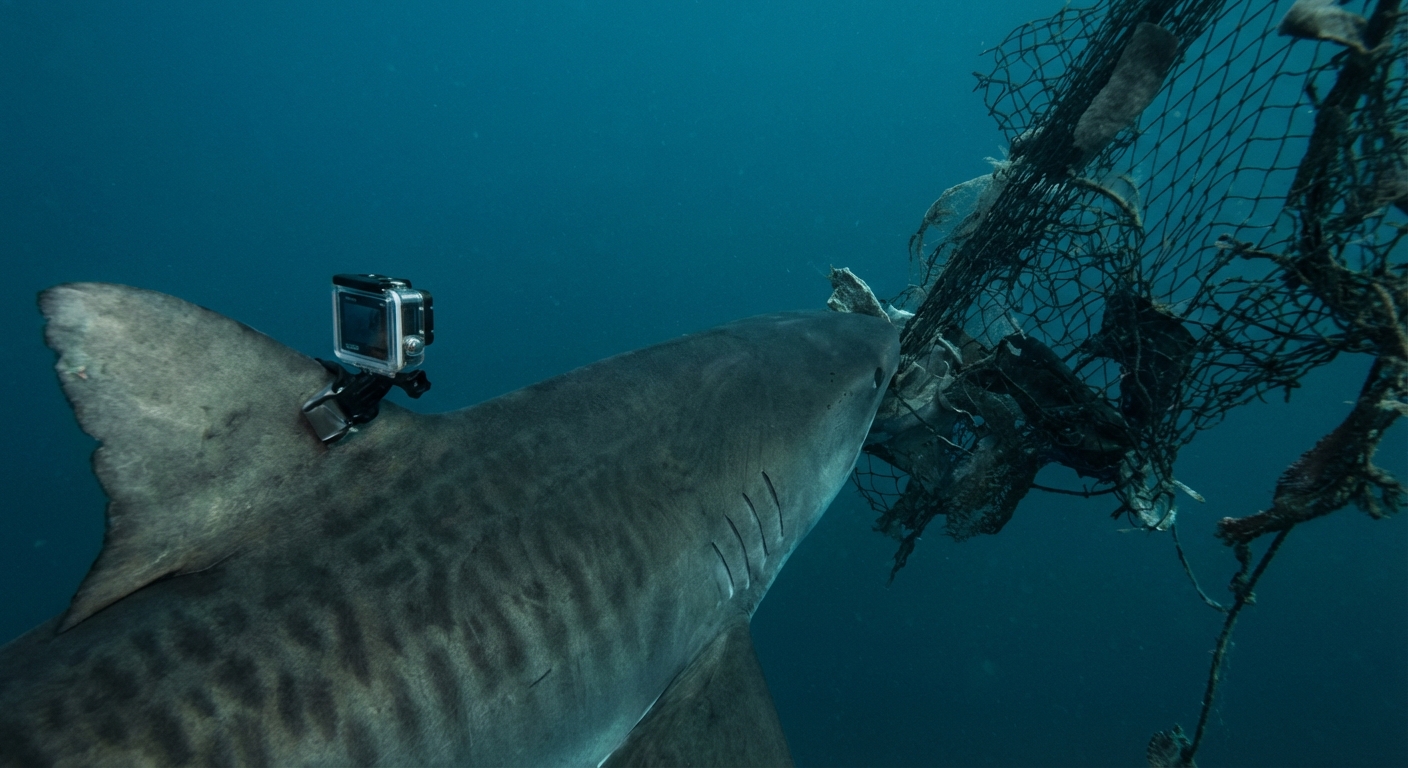
It started like any other research initiative. A team of marine scientists, equipped with specialized underwater cameras and tracking devices, set out to document the hunting patterns and daily behavior of great white sharks off the coast of South Africa. The camera was small, lightweight, and attached securely to the shark's dorsal fin—designed to capture hours of footage from the predator's perspective.
The researchers expected to see what they'd seen countless times before: hunting sequences, territorial displays, and feeding behaviors. They were prepared for raw footage of nature's brutal efficiency.
They were not prepared for what actually happened.
The Footage Nobody Expected
As the hours of video rolled in, something peculiar emerged. The shark wasn't hunting. It wasn't patrolling its territory. Instead, it was doing something that marine biologists had rarely—if ever—documented before.
The shark was playing.
But here's where it gets disturbing.
The creature wasn't playing with fish or other small prey. It was deliberately approaching boats, investigating swimmers from a distance, and engaging in what appeared to be deliberate, calculated interactions with humans. The movements were slow. Methodical. Almost... curious.
More troubling still? The shark seemed to be learning from each encounter, adjusting its behavior based on human reactions. It would approach, retreat, then approach again—each time from a slightly different angle, as if testing the boundaries of what it could get away with.
What Does This Behavior Actually Mean?
Marine biologists have been cautiously discussing these findings for months, and the consensus is far from reassuring: this behavior suggests a level of intelligence and social awareness in great white sharks that we fundamentally underestimated.
Dr. Sarah Chen, a leading shark behaviorist, stated in an interview: "What we're seeing isn't aggression. It's something more complex. It's investigation. It's problem-solving. And frankly, it's a bit unnerving because it suggests these animals are far more aware of us than we are of them."
The implications are staggering:
- Sharks may be capable of individual learning that persists across encounters
- They might be developing behavioral strategies specific to human interaction
- The line between instinct and conscious decision-making in these predators may be blurrier than we thought
Why This Matters—And Why You Should Care
For decades, we've operated under a comforting assumption: that sharks are essentially biological machines, driven purely by hunger and instinct. They attack because they're hungry or because they've mistaken us for seals. It's random. It's impersonal. It's predictable.
But if sharks are capable of deliberate, learned behavior around humans, the entire framework of shark safety changes. Beach protocols, diving guidelines, and our understanding of human-shark interactions all become more complicated.
The footage has been shared with only a select group of marine research institutions, but word is spreading through the scientific community. Some researchers are calling for expanded studies. Others are urging caution—both in the research itself and in how this information is released to the public.
The Rarest Glimpse Into a Predator's Mind
What makes this discovery even more extraordinary is how rare this type of footage actually is. Most shark camera projects capture hunting or feeding behavior—moments of explosive violence that last seconds. But this footage, spanning multiple hours and multiple encounters, offers something unprecedented: an intimate window into how a apex predator thinks when it's not driven by hunger.
Scientists are only now beginning to analyze the full implications. And they're not entirely sure what they're looking at.
What Happens Next?
The research team is planning a follow-up expedition later this year, with enhanced equipment and a larger sample size. They want to know if this behavior is unique to this individual shark, or if it's something more widespread. They want to understand the why behind these actions.
But until those answers come, we're left with an uncomfortable truth: the creatures we've long feared as mindless killing machines might be far more intelligent, far more aware, and far more capable of deliberate interaction than we ever imagined.
The ocean keeps its secrets well. But when it finally reveals them, they're rarely comforting.