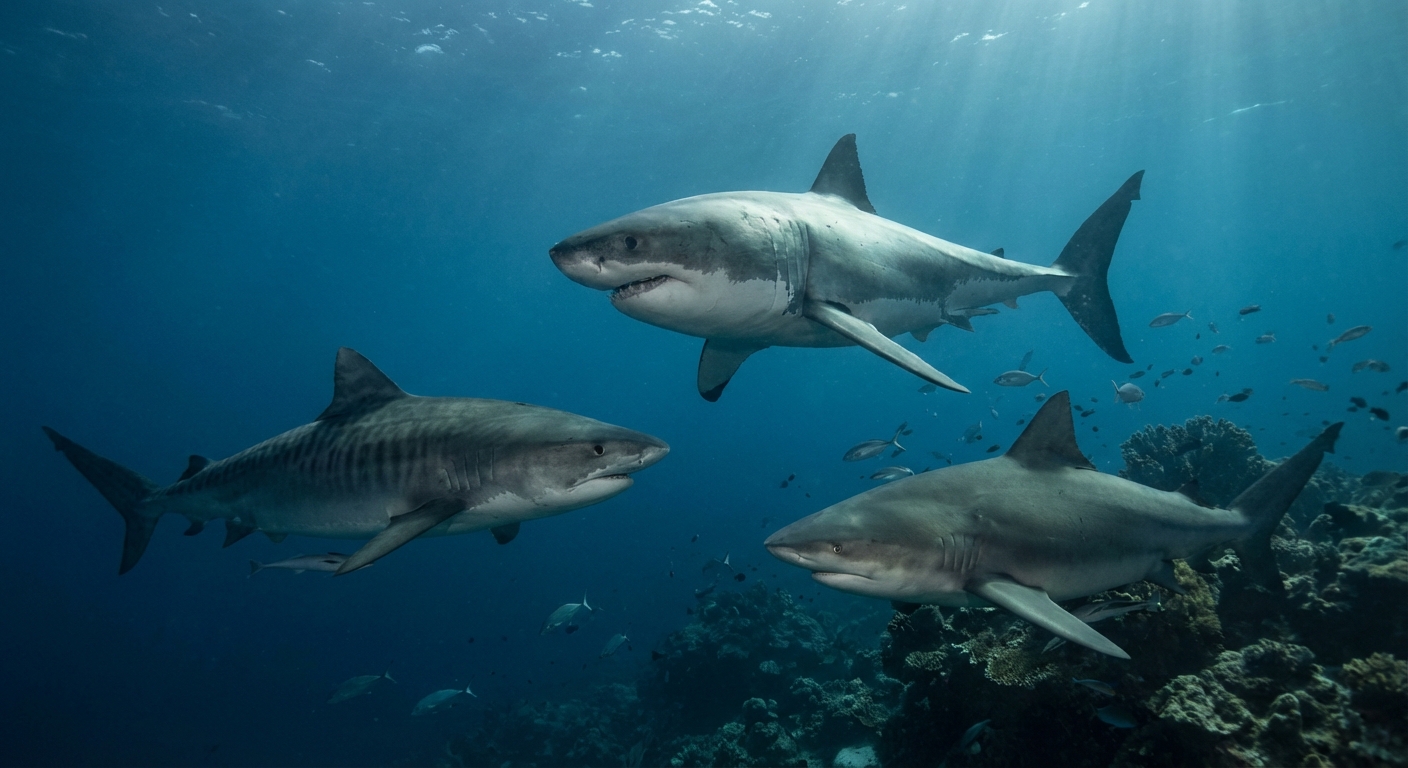
The Question That Haunts Marine Biologists
When you think of the ocean's deadliest predator, your mind probably conjures a specific image: the great white shark gliding through dark waters, rows of teeth glistening, or perhaps a tiger shark with its distinctive stripes cutting through the reef. But here's what marine scientists won't tell you in documentaries—the answer might not be what you expect.
For decades, we've built our fear on a foundation of Hollywood drama and sensational headlines. The great white has become synonymous with terror. The tiger shark earned its reputation through aggressive behavior. The bull shark? Well, it's known for venturing into rivers and attacking in murky water where visibility is near zero.
But the data tells a different story.
When Statistics Become Unsettling
Let's start with what we know for certain: shark attacks are rare. You're more likely to be struck by lightning than encounter a shark in its territory. Yet among the three notorious species, the numbers shift in unexpected ways.
The Great White: Approximately 314 recorded attacks worldwide (with about 11 fatalities per year globally). Powerful. Apex predator. Terrifyingly efficient.
The Tiger Shark: Around 111 recorded attacks. Slightly less common, but known for its indiscriminate feeding behavior—it'll eat almost anything it encounters.
The Bull Shark: This is where it gets disturbing. While it has fewer recorded attacks than the great white, bull sharks possess something the others don't: proximity to humans.
The Proximity Problem
Here's the unsettling truth that keeps marine biologists awake at night: the most dangerous shark might be the one you don't see coming.
Bull sharks can survive in both saltwater and freshwater. They've been found in rivers hundreds of miles from the ocean. They're smaller than great whites, which makes them less intimidating—and therefore more likely to approach humans without hesitation. They don't have the great white's natural wariness of our species. They investigate with teeth first.
In murky river water where visibility drops to inches, a bull shark becomes something else entirely: a predator without fear, without caution, without the learned behavior that keeps apex predators away from humans.
Tiger sharks, meanwhile, are known as the "garbage cans of the sea." They'll consume virtually anything: sea turtles, other sharks, license plates, human remains. Their lack of selectivity makes them unpredictably dangerous. A tiger shark won't refuse a meal because it's human.
The Great White's Unexpected Mercy
This is where the narrative inverts entirely.
Great white sharks, despite their fearsome reputation, have something resembling restraint. They're curious hunters, yes. They investigate. But studies suggest they often bite humans and then release—recognizing that we're not their preferred prey. A human doesn't have the fat content of a seal. We're not worth the energy expenditure.
The great white is dangerous because of its power and size. But it's also dangerous in a way that's almost... calculated. Measured. There's a logic to it.
The bull shark? The tiger shark? They're dangerous in a way that feels more random. More chaotic. Less predictable.
What Makes a Shark "Truly" Dangerous
If we measure danger by attack frequency, the great white wins. If we measure it by proximity to human populations and indiscriminate feeding behavior, the bull shark emerges as a threat that's harder to quantify, harder to prepare for.
The tiger shark occupies an eerie middle ground—powerful enough to inflict catastrophic damage, unpredictable enough to be genuinely terrifying, and present in warm waters where humans increasingly venture.
But here's the real answer that marine biologists struggle to articulate: the most dangerous shark is the one you're swimming with right now.
All three species kill humans. All three are capable of fatal attacks. But the danger isn't really about the shark itself—it's about context, location, behavior, and pure chance. It's about whether you're in its territory. Whether it's hungry. Whether it perceives you as a threat or a meal.
The Uncomfortable Truth
We want a definitive answer. We want to know which shark to fear most. We want to categorize danger and make it manageable.
But the ocean doesn't work that way.
What we can say with certainty: great white attacks are the most publicized. Bull shark attacks are the most unpredictable. Tiger shark attacks are the most indiscriminate. Each represents a different kind of threat—a different flavor of danger.
The unsettling part? Shark attacks remain statistically rare enough that the real danger might be our obsession with them. We fear what we see on screens more than what the data suggests we should fear.
And perhaps that's the most dangerous thing of all: not the sharks, but our inability to accurately assess risk in a world where the ocean remains fundamentally unknowable.