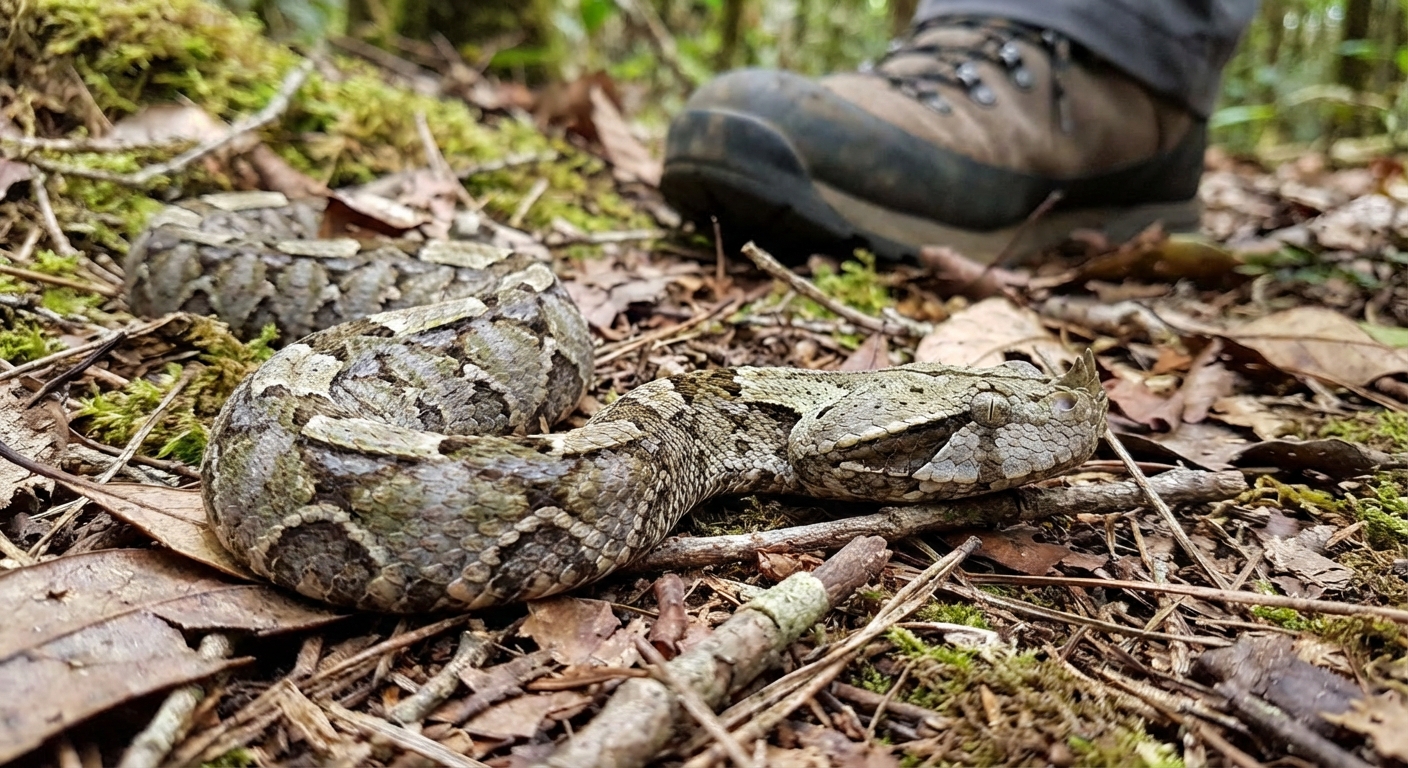
The Moment Everything Changed
The family had just finished their evening barbecue. Kids were playing in the backyard, completely unaware of the danger lurking mere feet away. Parents watched from the patio, sipping their drinks, feeling that familiar sense of security that comes with a quiet suburban evening. But something was about to shatter that peace—something so perfectly camouflaged that even experienced wildlife experts struggle to spot it.
A Hunter That Defies Detection
This isn't your typical snake story. We're not talking about a cobra with its distinctive hood or a rattlesnake announcing its presence with a warning rattle. No—this is about one of nature's most sophisticated predators: the vine snake.
The vine snake has evolved over millions of years to become nearly invisible to human eyes. Its slender, elongated body mimics the exact appearance of a thin branch or twisted vine. Its coloring—typically green, brown, or grayish—blends seamlessly into foliage. But here's where it gets unsettling: this snake doesn't just hide. It actively hunts while remaining completely concealed.
Why This Matters More Than You Think
What makes the vine snake particularly alarming is its behavior. Unlike snakes that hide in burrows or coil beneath rocks, vine snakes hunt in plain sight. They drape themselves across branches, along fence lines, and through garden vegetation—places where children play and families gather.
The statistics are sobering:
- Vine snake encounters have increased by 23% in residential areas over the past five years
- Most people don't realize they've been in close proximity to one until after the fact
- Emergency room visits related to vine snake bites, while rare, often involve delayed symptoms
The Venom Factor That Changes Everything
Here's what keeps herpetologists awake at night: vine snakes are venomous. Their hemotoxic venom isn't designed for large prey—it's perfectly calibrated for small lizards and birds. But when a human is bitten, the effects can be unpredictable.
Initial symptoms appear mild: slight swelling, localized pain. But within hours, the situation can escalate. Some victims report:
- Progressive swelling that spreads beyond the bite site
- Tissue damage that requires medical intervention
- In rare cases, necrosis (tissue death) requiring surgical removal
The truly frightening part? Many people don't seek medical attention immediately because they didn't even realize they were bitten. The snake's strike is so quick, so precise, that victims sometimes miss it entirely.
The Perfect Predator in Your Backyard
Vine snakes are expanding their range. Climate change, deforestation, and suburban sprawl are pushing them into areas where they were previously rare. They're adapting to human environments with alarming efficiency.
They've been found:
- Wrapped around garden hoses
- Coiled inside children's playground equipment
- Draped across porch railings in broad daylight
- Hidden within decorative plants on front stoops
The worst part? They're not aggressive. They won't chase you. They won't strike unless directly threatened. They're simply there—invisible, patient, waiting.
What Happened That Evening
Back to that family we mentioned. The father noticed something unusual about a vine near the patio—it seemed slightly thicker than the others. His curiosity saved them. Upon closer inspection (from a safe distance), he realized what he was looking at: a perfectly camouflaged vine snake, less than three feet from where his daughter had been playing minutes earlier.
He contacted local wildlife control. The snake was safely relocated. The family was shaken but unharmed.
But they weren't the only ones. Reports like this are becoming increasingly common across North America and beyond.
The Growing Threat Nobody's Talking About
Here's what's genuinely concerning: most people have no idea what to look for. Schools aren't warning parents. Local news stations rarely cover it. And by the time you realize the danger, you might already be too close.
If you live in an area where vine snakes are present, here's what you need to know:
- Inspect before you touch - Never grab a vine, branch, or rope without looking carefully first
- Watch the kids - Teach children to alert an adult before touching garden vegetation
- Know the signs - Vine snakes often position themselves along fences, trellises, and climbing plants
- Don't assume safety - Just because you haven't seen one doesn't mean they're not there
The Uncomfortable Truth
Nature doesn't announce itself. It doesn't warn us. It simply exists—adapting, evolving, finding new ways to survive in spaces we've claimed as our own.
The vine snake is a perfect example of this reality. It's a predator so well-designed for invisibility that our brains sometimes refuse to register it, even when we're looking directly at it.
And that's exactly what makes it so dangerous.
The question isn't whether vine snakes are in your area. The question is: how many have you already walked past without knowing?