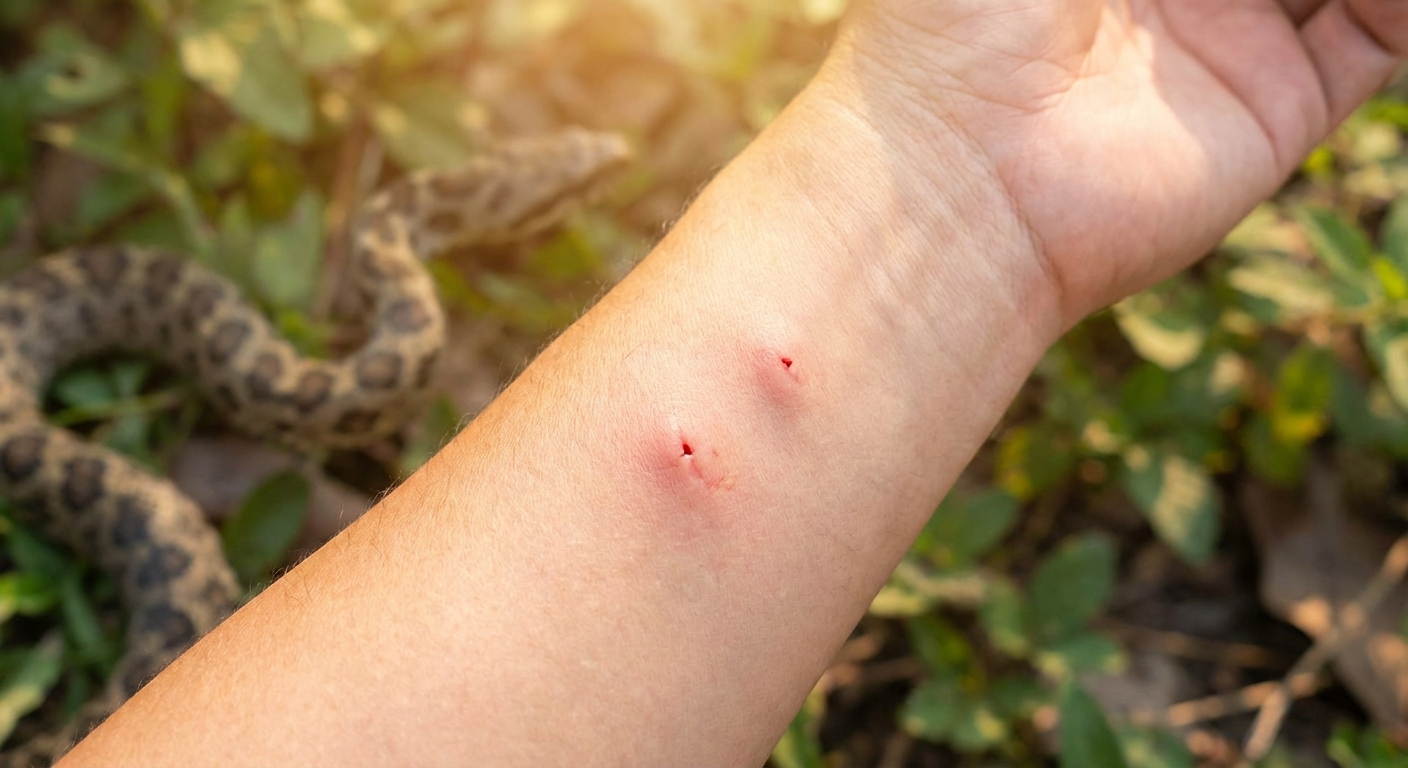
The Deadly Silence: Why Your Body Might Betray You After a Snake Bite
You feel the strike—a sudden puncture, maybe a slight sting. Your heart races for a moment. Then... nothing. No burning pain. No swelling. No obvious sign that venom is coursing through your veins.
This is the cruel trick that makes certain snake bites so dangerous.
The Illusion of Safety
When a snake bite feels painless, it's not a sign you're lucky. It's often a warning sign your body is failing to alert you to a genuine emergency. While some bites hurt immediately—sharp, burning, unmistakable—others arrive in silence, like a thief in the night.
The venom is still there. It's still working.
Why Your Body Lies to You
The sensation of pain depends on which nerves the venom targets. Some venoms are neurotoxins that attack the nervous system itself, paradoxically numbing the very warning system designed to protect you. Others are hemotoxins that destroy tissue from the inside out—damage you can't feel happening until it's catastrophically advanced.
The most insidious bites? Those from snakes like the elapids (cobras, mambas, coral snakes) and certain vipers. Their venom can take hours to show dramatic symptoms, but by then, irreversible damage is already underway.
A victim might feel fine at hour one. Weak at hour two. Paralyzed by hour three. Dead by hour four.
The Timeline Nobody Talks About
Here's what makes this terrifying: the absence of pain doesn't mean the absence of danger. Medical professionals call this the "latency period"—that deceptive window where you feel fine but your body is being systematically dismantled at the cellular level.
- First 30 minutes: Often symptom-free or minimal pain
- 1-3 hours: Subtle signs emerge (numbness, tingling, slight nausea)
- 3-6 hours: Severe symptoms accelerate (respiratory failure, coagulopathy, organ damage)
- Beyond 6 hours: Without treatment, often irreversible
The problem? Most people don't seek medical help during that painless window. They assume they're fine. They wait. And waiting is exactly what the venom wants.
Geographic Roulette: Where Painless Bites Are Most Common
Not all snakes are created equal. If you live in or travel to certain regions, your risk is exponentially higher:
Africa and Asia harbor some of the world's most dangerous silent strikers. The black mamba of East Africa can deliver a bite so painless that victims have continued conversations, walked to their cars, and driven themselves to hospitals—only to collapse minutes later. The many-banded krait of Southeast Asia is responsible for more deaths than almost any other snake, partly because its bites are so subtle that victims don't realize they've been bitten until paralysis sets in.
In contrast, vipers in the Americas typically cause immediate, excruciating pain—a built-in alarm system that usually sends victims to the hospital quickly enough for treatment.
The Venom Chemistry Behind the Silence
Scientists have identified the molecular mechanisms responsible for this deception. Certain neurotoxins bind to acetylcholine receptors, blocking the signals that create pain sensation. It's evolution's cruelest joke: the venom doesn't just kill—it prevents you from knowing you're being killed.
Phospholipase A2 (PLA2), found in many elapid venoms, works differently. It destroys cell membranes so gradually that you don't feel it happening. By the time symptoms arrive, the damage is systemic and often irreversible.
What Actually Happens Inside Your Body
While you're feeling fine, your venom is:
- Destroying red blood cells (hemolysis)
- Preventing blood clotting (coagulopathy)
- Paralyzing muscles (neurotoxicity)
- Triggering organ failure (nephrotoxicity, hepatotoxicity)
- Causing tissue necrosis (local destruction)
The painless bite is particularly insidious because it bypasses your body's most important defense mechanism: the fight-or-flight response. You don't run. You don't seek help. You sit there, feeling fine, while your body enters a state of medical crisis.
The Critical Window: Why Minutes Matter
This is where the story becomes a race against time. In hospitals equipped with antivenom, victims bitten by painless-bite snakes have a fighting chance—but only if they arrive before the venom has caused irreversible damage.
The problem? Many people don't even know they've been bitten.
In rural areas of India, Africa, and Southeast Asia, thousands of people die annually from snake bites they initially dismissed as insignificant. They worked through the "painless" hours. By the time they reached medical care, it was too late.
The Rarest, Most Dangerous Scenario
There's an even more terrifying subset: dry bites from venomous snakes, where no venom is injected. These feel completely painless and cause no symptoms—leading victims to believe they're safe when they might not be. But distinguishing a dry bite from a painless envenomation requires medical expertise and observation, not guesswork.
What You Should Actually Do
If you suspect a snake bite—even a painless one—the protocol is non-negotiable:
- Immobilize the bitten limb immediately
- Remove any constrictive items (rings, bracelets, watches)
- Seek medical attention within 30 minutes (this is critical)
- Don't attempt to identify the snake by catching it
- Don't apply tourniquets or try to suck out venom
- Get antivenom treatment as soon as possible
The absence of pain is not permission to wait. It's the opposite.
The Bottom Line: Silence Can Kill
Snake bites that feel painless are among nature's most deceptive killers. They exploit our assumption that pain equals danger—a cognitive bias that has cost thousands of lives. The venom works silently, systematically, relentlessly.
In many parts of the world, snake bites remain one of the leading causes of death from animal encounters, and painless bites are disproportionately represented in fatal cases. This is not a rare phenomenon. It's happening right now, in hospitals and remote villages across Africa, Asia, and beyond.
The next time you hear about someone dying from a "painless" snake bite, remember: they weren't unlucky. They were deceived by their own biology.