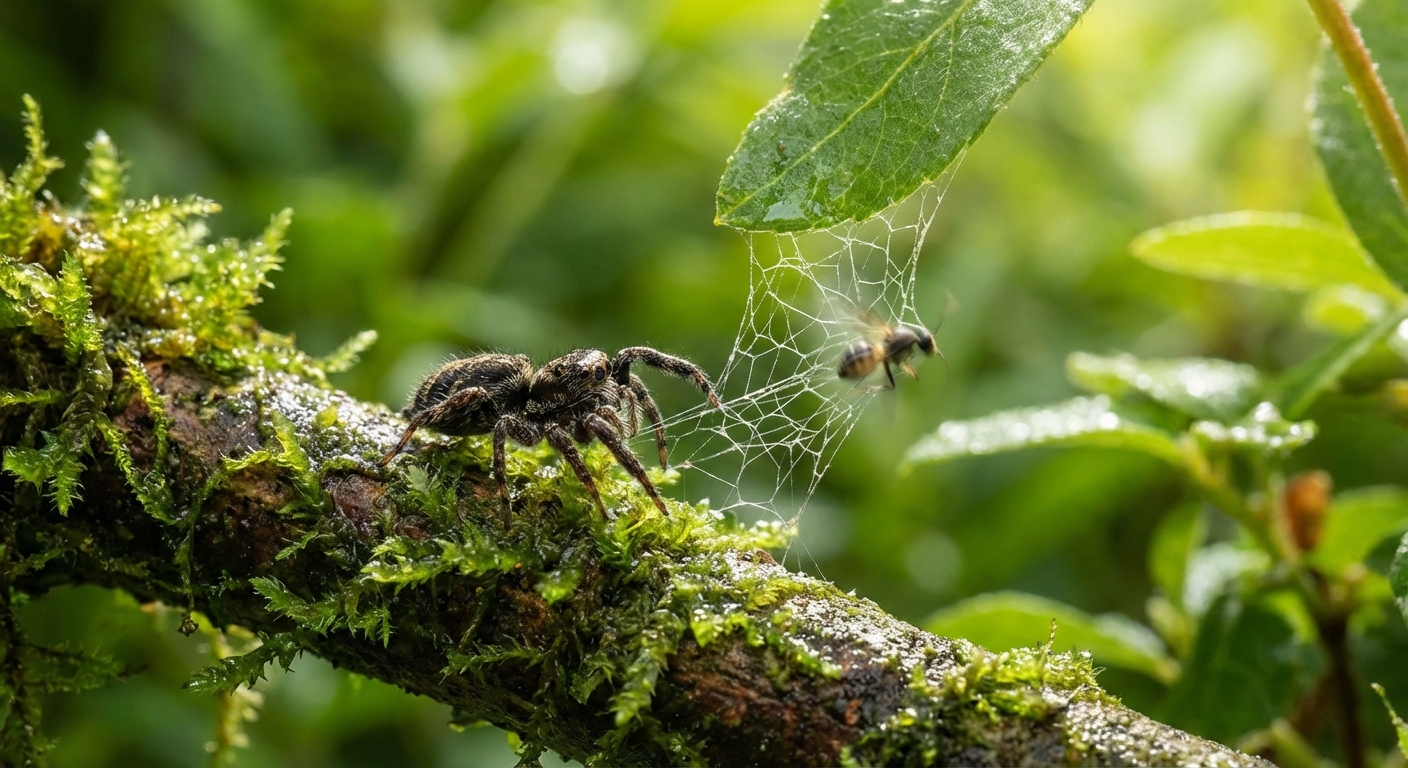
The Impossible Made Real: How One Spider Defies Everything We Thought We Knew
You're about to discover something that made arachnologists question their entire understanding of spider behavior. For decades, scientists believed certain hunting strategies were biologically impossible for spiders. Yet one remarkable species has been doing it all along—right under our noses.
When Nature Rewrites the Rules
The hunting world operates on strict biological laws. Predators have their niches. Strategies are locked into evolutionary pathways. Spiders, in particular, have always followed predictable patterns: web-builders spin, hunters stalk, ambush predators wait.
But what happens when a spider refuses to follow the script?
Recent research has unveiled a hunting technique so unconventional that it challenges fundamental assumptions about spider physiology and behavior. This isn't just a minor variation on existing tactics—it's a completely different approach to survival that experts once dismissed as theoretically impossible.
The Discovery That Changes Everything
The spider in question employs a strategy that combines elements scientists believed were mutually exclusive. Without spoiling the specifics just yet, imagine a predator that hunts like a spider but employs tactics we'd associate with entirely different species.
What makes this even more astonishing? This behavior isn't rare or accidental. It's deliberate, refined, and effective. The spider has mastered this technique to a degree that suggests it's been perfecting this approach for countless generations.
Why Scientists Missed It
The gap between discovery and recognition is often measured in decades. This particular hunting strategy went unnoticed because:
- It defies categorization. Traditional spider classification systems don't have a box for this behavior
- It's counterintuitive. Researchers didn't think to look for it because the physics seemed wrong
- It challenges established dogma. When something contradicts textbooks, it takes extraordinary evidence to convince the scientific community
This is precisely why the recent documentation has sent shockwaves through the arachnological community.
The Hunting Strategy Unveiled
The spider achieves something previously thought impossible: it hunts with a level of behavioral flexibility that rivals much larger, more complex predators. Rather than relying on a single, hardwired hunting pattern, this species adapts its approach based on environmental conditions and prey availability.
The mechanics involve:
- Deceptive positioning that exploits prey perception gaps
- Timing-based strikes that require split-second decision-making
- Environmental manipulation to create hunting advantages
- Tactical switching between multiple hunting modes
Each element alone would be remarkable. Combined, they represent a level of cognitive sophistication we rarely attribute to arachnids.
The Implications That Keep Scientists Awake
This discovery raises uncomfortable questions:
How many other "impossible" behaviors are happening right now in nature? If we were wrong about this spider, what else have we gotten wrong? The implications extend beyond simple curiosity—they fundamentally alter how we understand predator-prey dynamics, spider evolution, and animal intelligence itself.
The species in question remains relatively obscure, which means there's likely much more to discover. As more researchers turn their attention to this phenomenon, we may be on the cusp of rewriting entire chapters of arachnological science.
What This Means for the Future
This discovery serves as a humbling reminder: nature is far more creative than our theories allow. For every hunting strategy we've documented, there may be dozens we haven't yet recognized. The spiders that have mastered the "impossible" are out there, and they're thriving.
The real question isn't whether this spider's strategy works—clearly it does. The real question is: what else have we been blind to?