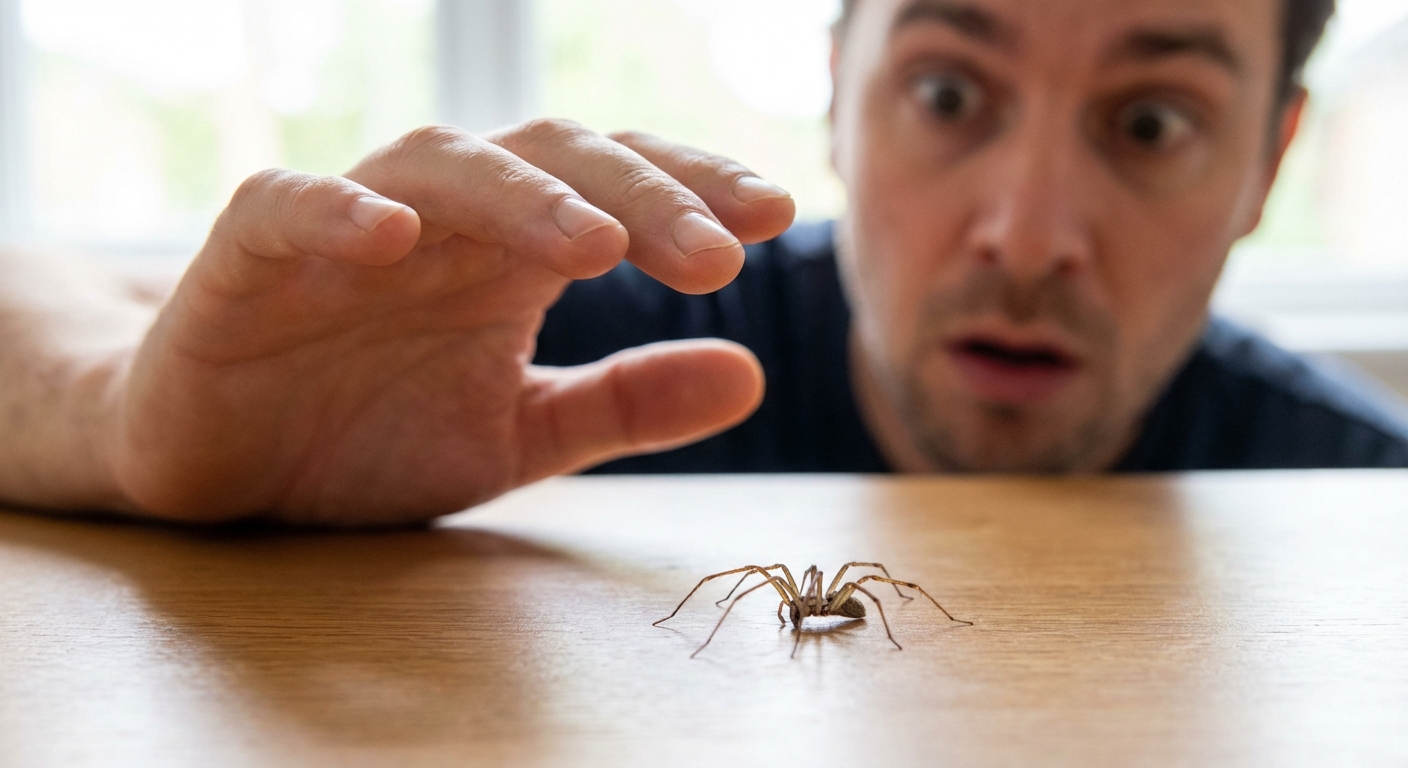
The Primal Terror That Science Can't Fully Explain
Your heart races. Your palms sweat. Your breath catches in your throat.
A spider—harmless, tiny, utterly indifferent to your existence—appears in your peripheral vision, and suddenly you're gripped by a fear so visceral, so overwhelming, that rational thought becomes impossible. You're not alone. In fact, you're part of a global phenomenon that affects millions of people daily, and researchers still don't have all the answers about why.
What makes this even more unsettling? The spider you're terrified of might be one of the thousands of species that couldn't hurt you even if it wanted to.
Why Your Brain Betrays You
Here's where it gets interesting: arachnophobia isn't just about the spider itself. It's about what your brain thinks the spider might do.
Your amygdala—the ancient, survival-focused part of your brain—processes images of spiders at lightning speed, often before your conscious mind even registers what you're seeing. This is called the "fear module," and it evolved over millions of years to keep your ancestors alive. Back then, a spider bite could mean death. Today? Most spiders in your home pose zero threat.
But your amygdala doesn't know that.
The problem is that this fear response fires indiscriminately. A huntsman spider, a wolf spider, a daddy longlegs—your nervous system treats them all like potential assassins. Your pupils dilate. Your muscles tense. You might scream, jump, or freeze. Some people report feeling an inexplicable sense of being watched, of danger lurking just beyond perception.
The truly disturbing part? This happens even when you consciously know the spider is harmless.
The Evolutionary Mystery That Remains Unsolved
Scientists have long theorized that arachnophobia is an evolutionary adaptation. The theory goes: humans who feared spiders were more cautious, more likely to survive a venomous bite, and therefore more likely to pass on their genes.
But here's what complicates this neat explanation—we don't actually have data supporting this. Snakes kill far more humans than spiders ever have. Yet while many people fear snakes, the prevalence of arachnophobia is significantly higher. Why would evolution make us more afraid of the less dangerous threat?
Some researchers now suspect it's not about danger at all. It might be about unpredictability. Spiders move in ways that seem erratic to human eyes. Their multiple legs create movement patterns that our visual system struggles to predict. Their sudden, jerky motions trigger the same alarm bells that go off when we see something moving in an unexpected way—a potential predator, a threat.
Then there's the "disgust factor" that nobody talks about enough. Spiders are alien-looking. Eight legs. Multiple eyes arranged in ways that don't match any mammal. Their bodies seem to bend and fold in unnatural ways. Some research suggests that arachnophobia isn't purely fear—it's a cocktail of fear, disgust, and a deep sense of wrongness.
The Catch: Your Fear Might Be Contagious
Here's something that should genuinely concern you: arachnophobia spreads.
Studies show that children who watch their parents react with fear to spiders are significantly more likely to develop arachnophobia themselves. You don't even need to have a traumatic experience with a spider to develop a crippling fear of them. Observing someone else's terror is enough.
And in our age of social media, where videos of spiders—some real, some exaggerated—circulate constantly, this learned fear is reaching unprecedented levels. A video of a huntsman spider in Australia gets millions of views, each viewer absorbing the terror embedded in the comments, the screams, the dramatic music added in post-production.
Your fear might not even be truly yours. It might be inherited from your mother, or learned from a viral video you watched five years ago.
The Ones You Should Actually Worry About (Spoiler: Still Not Many)
Let's address the elephant in the room: are there actually dangerous spiders?
Yes. But they're vanishingly rare in most people's lives.
The Sydney funnel-web spider has a venom potent enough to kill a human. The Brazilian wandering spider is considered the most venomous spider on Earth. But these spiders live in specific regions, and they're not aggressive. They bite only when directly threatened, when you're pressing them against your skin or stepping on them.
The spiders in your house? The ones causing your panic attacks? They eat insects. They're actually working for you, maintaining the ecosystem of your home. A common house spider has venom designed for insects, not humans. Its fangs are too small to pierce human skin in most cases.
Yet knowing this doesn't stop the fear.
And that's the real horror of arachnophobia—it's immune to logic. You can recite facts about spider venom. You can remind yourself that they're beneficial. You can watch educational videos about how spiders help control pest populations. None of it matters when you see one skittering across your wall at 2 AM.
The Unsettling Truth We're Only Beginning to Understand
Recent neuroscience research has revealed something that might explain why arachnophobia is so stubborn: the fear response to spiders activates different neural pathways than other phobias.
When you see a spider, your brain doesn't just activate fear circuits. It also activates regions associated with threat detection, visual processing, and something called "biological motion perception." Your brain is essentially running multiple threat-assessment programs simultaneously, cross-referencing the spider's movement against every predator your ancestors ever feared.
This multi-system activation means that arachnophobia isn't a simple fear you can logic away. It's wired into the very architecture of your perception.
Some researchers are now exploring whether virtual reality exposure therapy might help rewire these neural pathways. Early results are promising, but the fact that we need high-tech interventions to overcome a fear of a creature that poses minimal threat speaks volumes about how deeply this fear is embedded in human neurology.
What This Means for You
If you have arachnophobia, you're not overreacting. You're not being irrational (or at least, not in the way you think you are). Your brain is doing exactly what it evolved to do—protect you from perceived threats.
The problem is that your brain's threat-detection system is operating on ancient software running on modern hardware, and it hasn't received an update in thousands of years.
The spider on your wall isn't a threat. But the fear it triggers? That's real. That's neurological. That's ancient human survival instinct colliding with the modern world.
And until neuroscience gives us better answers about why some of us are wired this way, the only honest thing we can say is: we still don't fully understand why a creature so small can make us feel so afraid.