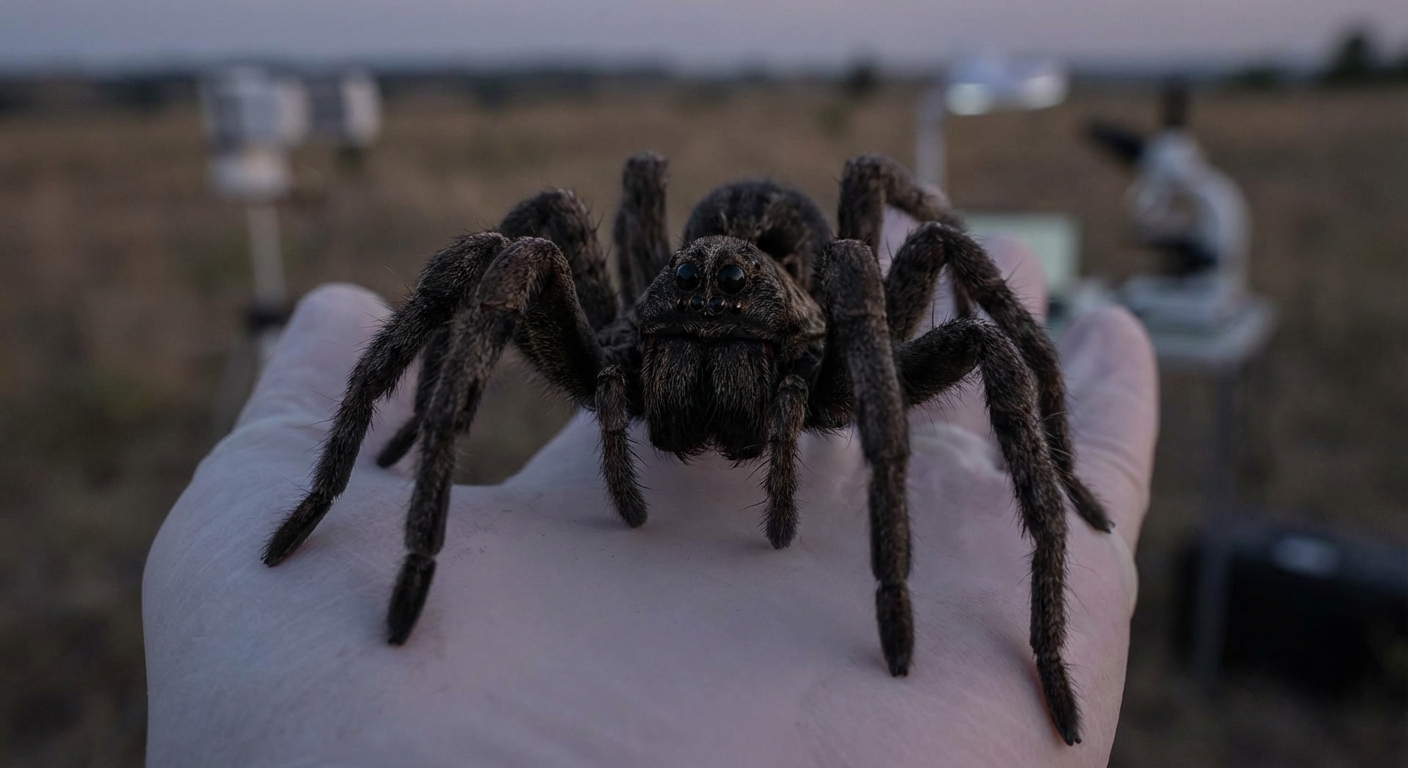
The Moment That Changed Everything
You're about to watch something that made arachnologists—scientists who dedicate their entire careers to spiders—genuinely uncomfortable. Not squeamish. Not mildly disturbed. Uncomfortable in a way that suggests they've seen something they weren't quite prepared to explain.
The video surfaced quietly in 2023, shared across specialized research forums before slowly making its way into the mainstream consciousness. What makes it different from the thousands of spider videos flooding social media? The researchers themselves refuse to fully explain what they're witnessing.
The Setup: A Normal Day in the Lab
It started innocuously enough. A team of entomologists was conducting routine behavioral observations on a colony of Phidippus regius—the jumping spider, a species known for its surprising intelligence and curiosity. These spiders are considered relatively harmless, even endearing. They have large forward-facing eyes that give them an almost puppy-like appearance. People keep them as pets.
The researchers were simply documenting feeding patterns. Standard protocol. Nothing extraordinary was expected.
Then the camera caught something.
Escalation: When Patterns Break
The footage shows a single spider engaging in what can only be described as deliberate problem-solving, but in a way that violates established behavioral models. The spider doesn't just hunt—it appears to be planning.
What disturbs researchers most isn't aggression or unusual predatory behavior. It's the intentionality. The spider seems to understand cause and effect in ways that shouldn't be possible for a creature with a brain the size of a pinhead. It manipulates objects. It tests variables. It experiments.
One researcher commented anonymously: "We've documented tool use before. We've seen intelligence. But this... this looked like it was thinking three steps ahead."
The Unsettling Part: What They Won't Say
Here's where it gets genuinely eerie: the research team has been deliberately vague about the full contents of the video. They've published findings. They've presented data. But they consistently sidestep the most direct questions about what the spider was actually doing in those final seconds of footage.
Speculation has filled the void:
- Was the spider exhibiting signs of metacognition—thinking about its own thinking?
- Did it demonstrate an understanding of its own mortality?
- Was there evidence of communication or coordination that suggests something we don't have language for?
The scientific community remains divided. Some argue the team is overcautious. Others suggest they're protecting something far more significant than they're willing to admit publicly.
Why This Matters: The Uncomfortable Truth
Spiders have existed for over 380 million years. They've survived five mass extinction events. They're found on every continent except Antarctica. We've always assumed we understood them—simple creatures operating on pure instinct, their behavior governed by genetics and reflexes.
But what if that assumption was incomplete?
The video forces us to confront an unsettling possibility: that intelligence, awareness, and intentionality might exist on scales and in forms we've never bothered to recognize. Not because they're rare, but because we've never looked carefully enough.
The Rarity Factor: This Changes Everything
Footage this compelling, combined with this level of scientific hesitation, is extraordinarily rare. Most viral animal videos get debunked within days. Most "shocking" discoveries turn out to be misinterpretations or anthropomorphization.
This one hasn't.
Three years later, the video remains largely uncontradicted by the scientific community. No researcher has stepped forward to explain it away as artifact or misunderstanding. The original team continues their research in relative silence.
The question hanging in the air: What else are we missing about the creatures sharing our world?